
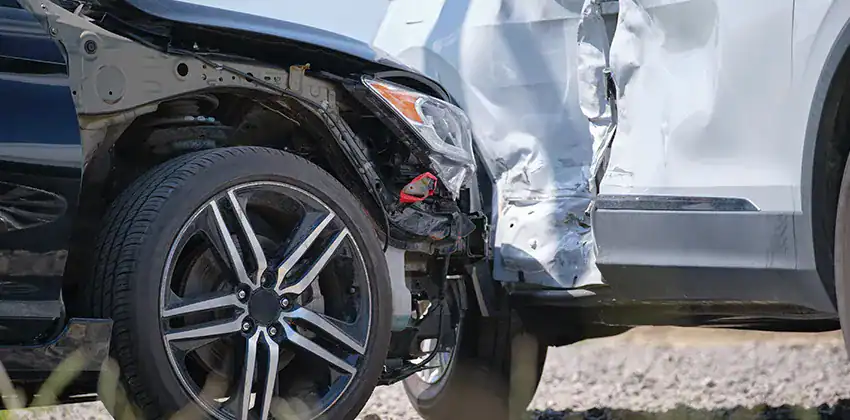
Reviewed against Virginia sources current as of August 20, 2026. A Virginia Beach car collision can involve separate questions about conduct at the scene, negligence, insurance coverage, injury, property damage, and filing deadlines. The police report, policy documents, medical information, and the facts of the collision must be reviewed before anyone can assess a particular claim.
This page focuses on passenger-car collisions in Virginia Beach. It does not assume that a crash proves fault, that an injury was caused by the crash, that insurance provides coverage, or that compensation is available.
The Virginia Department of Motor Vehicles’ 2025 Traffic Crash Facts report lists 4,965 reported crashes in Virginia Beach, with 28 fatalities and 3,102 injuries. These jurisdiction-level counts describe reported traffic-crash data for that year. They do not identify fault, legal merit, claim value, injury severity in a particular collision, the number of lawsuits, or matters handled by any law firm.
| Locality | Reported crashes | Fatalities | Injuries |
|---|---|---|---|
| Virginia Beach City | 4,965 | 28 | 3,102 |
Source: Virginia DMV, 2025 Virginia Traffic Crash Facts, “What Happened in Virginia Counties and Cities,” printed page 4. Data year: 2025. Page data reviewed: August 23, 2026.
Virginia Code § 46.2-894 addresses a driver’s duties when a collision involves injury, death, or damage to an attended vehicle or other attended property. The statute covers stopping near the scene without obstructing traffic, reporting specified identifying information, and rendering reasonable assistance to an injured person. Section 46.2-371 separately requires immediate notice to a law-enforcement officer when a crash results in injury or death.
Immediate safety and health needs come first. Call 911 for an emergency. Decisions about examination, diagnosis, or treatment should be based on a person’s health and advice from a qualified health-care professional—not on a suggestion that treatment should be obtained to create a legal record. A legal webpage cannot diagnose an injury or prescribe care.
The Virginia Model Jury Instructions—Civil define negligence as the failure to use ordinary care. In a negligence case, the plaintiff generally has the burden to prove that the defendant was negligent, that the negligence was a proximate cause of the collision and injury, and that the plaintiff sustained legally recoverable damages. The fact that a collision occurred and someone was injured does not, by itself, establish negligence.
The plaintiff is the person bringing the civil claim; the defendant is the person or entity against whom the claim is brought. Each alleged act, causal link, injury, and item of loss must be evaluated in the correct role. A citation or police opinion may be relevant, but it does not automatically decide every issue in a civil case.
Virginia has separate traffic rules for different driving movements. The applicable statute and evidence depend on the actual event; a collision label is not a finding of fault.
Virginia Code § 46.2-816 prohibits following another vehicle more closely than is reasonable and prudent, considering vehicle speeds, traffic, and highway conditions. Vehicle position, stopping sequence, visibility, traffic flow, and witness or video evidence may all matter. A rear impact should not be treated as an automatic answer to every negligence or causation question.
Virginia Code § 46.2-825 addresses when left-turning traffic must yield and how a separate left-turn signal affects right of way. Signal phase, lane position, direction of travel, sight lines, vehicle speed, and independent recordings may be relevant in an intersection case.
Virginia Code § 46.2-804 includes lane-use rules, including the requirement to ascertain that movement from a lane can be made safely. Section 46.2-848 addresses safety and signaling before backing, stopping, turning, or partly turning from a direct line. The evidence must be compared with the text of the statute that actually applies.
The exact street, intersection, direction of travel, lane, traffic control, responding agency, and time can affect which records may exist and where a person can ask for them. An official travel page or live camera does not decide fault, and the existence or retention of footage cannot be assumed.
The Virginia civil model instructions explain that contributory negligence is a failure to act as a reasonable person would for that person’s own safety. When both parties’ negligence proximately contributes to a collision, the instructions state that the negligence is not compared and that contributory negligence can bar recovery.
That rule does not make a driver’s accusation, an insurer’s position, or a percentage written in a report conclusive. The facts, applicable duties, causation, available defenses, and recognized exceptions require legal analysis. A webpage cannot determine whether a person was contributorily negligent.
Materials relevant to a passenger-car collision may include records that already exist or are received in the ordinary course of the event, such as:
Virginia Code § 46.2-380 identifies who may inspect or obtain specified police crash reports. The Virginia DMV crash-report page provides the current request process. Keep original records intact, note their source and date, and do not alter evidence or access an account or system without authorization.
A collision may involve liability coverage, a person’s own policy, a household policy, medical-expense coverage, rental or property-damage provisions, or uninsured and underinsured motorist coverage. Virginia Code § 38.2-2206 governs uninsured and underinsured motorist coverage, but the actual policy, coverage elections, vehicle use, insured status, available limits, and claim facts must be reviewed.
It is not accurate to assume that every insurer follows the same process, that every first offer is inadequate, or that a claim will settle. A settlement usually involves written terms and may include a release. A person is not generally required to hire a lawyer merely to receive or accept an offer, but a general webpage cannot determine the legal or financial effect of a particular offer, authorization, release, or payment.
These statutes do not create one universal deadline for every collision-related matter. The claim type, parties, date of accrual, government involvement, age or capacity, death, prior filings, and related proceedings may change the analysis. Do not rely on a two-year shorthand without reviewing the actual facts and current law.
The Virginia civil model instructions identify categories a factfinder may consider when supported by the evidence, including bodily injury and its effects, reasonable medical expenses, lost earnings or diminished earning capacity, property damage, pain, inconvenience, disfigurement, and other proven loss. The plaintiff has the burden to prove each claimed item and that it was caused by the defendant’s negligence.
Not every category applies in every case. A bill, diagnosis, missed workday, repair estimate, or insurance letter does not establish the legal cause, reasonableness, amount, or recoverability of a claimed loss by itself. No responsible estimate of case value can be made from a short online description.
Early questions can help organize an individual review without deciding fault, coverage, deadlines, or the appropriate next step:
These are issue-spotting questions, not instructions or a guaranteed legal workflow. The appropriate path may involve further investigation, an insurance claim, negotiation, litigation, or no viable claim. A law firm should not promise a settlement, trial, recovery amount, or fixed sequence before completing an individual review and agreeing to representation.
The following government pages provide general records, travel, insurance, data, and court information. They do not decide fault, venue, coverage, entitlement to records, claim value, or whether a matter belongs in a particular court:
No single record automatically decides civil liability. A report can contain useful observations and identifying information, but admissibility, accuracy, witness knowledge, other evidence, and the governing law still matter.
Not necessarily. A person may receive or consider an offer without counsel. Whether accepting it is appropriate depends on the facts, coverage, documented losses, unresolved issues, liens or reimbursement claims, and the release or other written terms.
The policies and coverage elections must be examined. The identity of an insured person, priority among policies, available limits, reporting requirements, and the conditions in § 38.2-2206 can affect the analysis. Do not assume that coverage exists or does not exist based only on what was said at the scene.
That cannot be predicted from the collision alone. Some matters resolve without a lawsuit, some are disputed, and some proceed through litigation. Liability, causation, damages, coverage, deadlines, evidence, and the parties’ decisions all affect the path.
No. The proceedings are distinct, but a related prosecution, evidence, plea, conviction, or order may affect civil procedure or analysis. Section 8.01-229 also contains a tolling provision for certain civil actions when a criminal prosecution arising from the same facts is pending. The specific records and procedural status must be reviewed.
This page is limited to passenger-car collisions. For the firm’s broader vehicle-collision information, visit the Virginia Beach motor vehicle accident page. For the firm’s broader city-level injury overview and verified practice scope, visit the Virginia Beach personal injury page. For related regional information, visit the Hampton Roads motor vehicle accident page.
The Phoenix Trial Firm’s public practice pages describe representation in vehicle-collision matters in Virginia Beach and throughout Hampton Roads. Visitors can also read the firm’s Dante Wright profile. To ask whether the firm is available to review a Virginia Beach passenger-car collision matter, call 757-777-9285 or use the firm’s contact page. A request does not mean that the firm has accepted the matter.
This page provides general information, not legal or medical advice. Reading it or contacting the firm does not by itself create an attorney-client relationship. Do not send confidential or time-sensitive information through a website form.

Recovered $60,000 for a client injured in an automobile accident.
Recovered $80,000 for a client injured in an automobile accident.
Recovered $100,000 for a client injured in an automobile accident.
Recovered $150,000 for a client injured in an automobile accident.
Recovered $45,000 for a client injured in an automobile accident.

"*" indicates required fields
1807 S. Church Street, Suite 200C
Smithfield, VA 23430
2 Eaton Street, Suite 900
Hampton, VA 23669
Copyright © 2026 The Phoenix Trial Firm• All Rights Reserved. Disclaimer | Site Map | Privacy Policy. Digital Marketing By: 